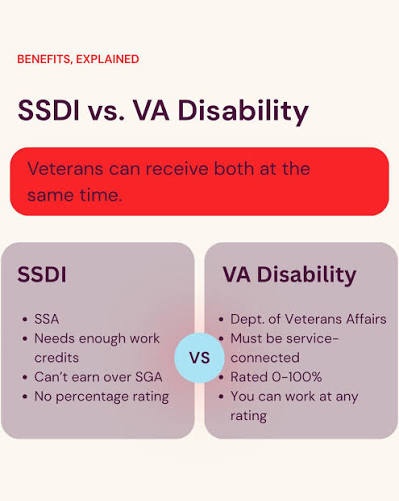
Veterans who develop a serious illness or injury may have access to more than one disability benefit program. However, qualifying for one program does not automatically mean a person qualifies for another. Each federal agency applies its own eligibility requirements, definition of disability, and evaluation process.
Understanding how these programs differ can help veterans organize their medical evidence, employment history, and applications more effectively. It can also prevent a common misconception: receiving a high disability rating from one agency does not automatically guarantee approval from the other.
The Social Security Administration and Department of Veterans Affairs evaluate disability for different purposes. VA disability compensation generally focuses on whether a condition is connected to military service and how severely that condition affects the veteran. VA disability compensation is based on a disability rating, while SSDI focuses on whether a qualifying impairment prevents substantial gainful work and meets Social Security's duration requirements.
These differences are important when evaluating ssdi and va disability because the same medical condition can produce different outcomes under the two programs. A veteran could receive VA compensation but still need to establish separately that the condition prevents substantial gainful activity under Social Security's rules.
VA disability compensation provides monthly, tax-free payments to eligible veterans with disabilities connected to military service. The VA considers evidence such as medical records, examination results, and other relevant information when assigning a disability rating.
A service connection can involve a condition that began during military service, was aggravated by service, or qualifies under certain presumptive rules. VA disability ratings generally range from 10% to 100%, with compensation determined according to the applicable rating and other factors.
The VA's approach therefore differs substantially from Social Security's work-focused disability standard. A veteran may have a service-connected condition and receive VA compensation even if that condition does not prevent all employment.
Social Security Disability Insurance is designed for workers who have accumulated sufficient work credits and have a qualifying disability. The SSA requires an impairment to prevent substantial gainful activity and to have lasted, or be expected to last, at least 12 months or result in death.
Unlike VA compensation, SSDI does not require the disabling condition to have originated during military service. A veteran can potentially qualify because of a medical condition regardless of whether it is service-connected.
Social Security also considers vocational factors that do not play the same role in VA disability ratings. Depending on the circumstances, age, education, work experience, and ability to perform other work can affect the disability determination.
Yes. Veterans may potentially receive both VA disability compensation and SSDI when they independently satisfy the requirements of each program. The SSA specifically states that VA disability compensation and SSDI do not affect each other for eligibility and benefit purposes, although separate applications are required.
This means a veteran should not assume that applying for one program eliminates the possibility of applying for the other. Instead, each claim should be evaluated according to the rules of the agency responsible for making the decision.
The evidence used for one claim may still be relevant to another. Medical records, treatment histories, functional limitations, and employment documentation can help establish the broader impact of a disabling condition.
One of the most important distinctions involves the VA disability rating. A 100% VA rating does not automatically establish entitlement to SSDI because the programs use different standards. The SSA specifically notes that even a high VA compensation rating does not by itself mean a veteran qualifies for Social Security disability benefits.
For SSDI, the central issue is the individual's ability to perform substantial gainful activity. The analysis may involve determining whether the person can return to past relevant work and, when appropriate, whether other work exists that the individual can perform considering the documented limitations and vocational factors.
This makes detailed employment information particularly valuable in complicated claims.
Medical evidence can establish diagnoses, treatment history, symptoms, restrictions, and functional limitations. However, medical evidence alone may not fully explain how those limitations affect a person's ability to perform specific occupations.
Vocational evidence can help connect functional restrictions with actual job requirements. An evaluator may examine education, employment history, transferable skills, job duties, physical demands, cognitive requirements, and labor-market factors.
This can be especially relevant for veterans whose conditions affect their ability to perform work they previously handled successfully. A detailed employment analysis can help clarify whether limitations prevent a return to previous work or restrict access to other occupations.
Some veterans may also encounter VA's Individual Unemployability program. This benefit can allow certain veterans to receive compensation at the 100% rate when service-connected disabilities prevent substantially gainful employment, even though their combined disability rating is not 100%.
The VA has specific eligibility requirements for Individual Unemployability, including rating thresholds and evidence showing that service-connected disabilities prevent substantially gainful employment.
This is another example of why veterans should distinguish between different disability programs rather than treating every disability determination as interchangeable.
Veterans pursuing disability benefits should maintain organized documentation and provide accurate information to the appropriate agency. Useful evidence may include:
A consistent record can make it easier for decision-makers to understand the relationship between a medical condition and its effect on employment.
For veterans pursuing ssdi and va disability, it is particularly important to understand that evidence should address the requirements of each program separately. A document that establishes service connection for VA purposes may not answer Social Security's questions about sustained work capacity.
Navigating federal disability programs can become complicated when medical conditions, military service, employment history, and long-term earning capacity intersect. Although VA disability compensation and SSDI may provide valuable support, they operate under different standards and require separate applications.
Veterans should therefore avoid assuming that approval under one program guarantees approval under another. Careful documentation, accurate medical evidence, and a clear understanding of work-related limitations can help present a more complete picture of the individual's circumstances.
When disability affects long-term employment, professional vocational analysis may also provide useful insight into employability, transferable skills, and future work capacity. Ultimately, understanding the distinction between these programs allows veterans to approach each claim according to the rules that actually govern it.

This post has been authored and published by one of our premium contributors, who are experts in their fields. They bring high-quality, well-researched content that adds significant value to our platform.








Photography Shots is your source for photography tips, camera guides, editing tutorials, and creative inspiration. Capture moments, tell stories, and improve your photography skills.
